


9 interesting facts about your sewing machine

This January marks 18 years since I got my first sewing machine - and even though I've been literally sewing for half of my life, I still find new things to learn about it. In this article, I want to share 9 surprising things you may not know about your sewing machine.

This article is created in partnership with Brother. Lots of these tips are from the very detailed Brother sewing machine manuals!
Click below to watch video version and scroll down to read:
The correct way to wind a bobbin.
For years, I would start winding the bobbin by wrapping thread around a few times and then continue winding on the machine. Turns out - this is not the correct way to do it! The right way is to push thread through the hole at the bobbin top, install bobbin into the winder (holding the thread) and start winding the bobbin. After the thread is winded a bit, clip thread end and continue winding the bobbin until full. This way, the bobbin is winded with equal thread tension all throughout, resulting in equal stitch quality.

Push thread through the small hole at the top of the bobbin 
Holding thread, install bobbin in the winder and start winding (Brother CS10s sewing machine) Bobbin top marking.
Speaking of bobbin, the plastic bobbin has a marking (a small letter 'b' on Brother machine models) showing which way should be facing upwards when placing in the winder and in the bobbin holder - no more guessing games!

In Brother sewing machine range, bobbin top is indicated with a letter 'b' Winding bobbin at slow speed for stretchy threads.
Admittedly, I always wind my bobbin at max speed (for obvious reason: I want it winded quickly!). But, if you're working with threads that are stretchy - like elastic sewing thread or clear filament thread - you may want to wind the bobbin on slowest setting, so that the thread is not pre-stretched before going into seam.

Wind stretchy threads using slowest speed setting (Brother Innov-is A65 sewing machine) Plastic bobbins for top loading sewing machines.
Years ago, I bought metal bobbins for my top loading sewing machine, thinking they would be more durable, but they ended up causing irregular stitches - I couldn't figure out why that was happening. Turns out, the bobbin case in top loading machine is magnetic (supposedly to catch any broken needle ends) - which means that using metal bobbin would result in slower rotation, throwing off the timing of the sewing machine. So, if you want consistent quality results - best to use the exact type and material bobbin that your machine came with.

The bobbin case for top loading machines is magnetic, making it suitable for plastic bobbins only Rotating handwheel only towards you.
Now that we're on the topic of machine timing, there's one more thing that can throw it off: rotating handwheel in the wrong direction. In sewing machine, every detail and every motion is tiny and all about precision - because of that, the handwheel should be rotated only towards you, to keep machine rhythm in tact.

Turn sewing machine handwheel only towards you to maintain machine timing Presser foot has two height options.
The first time I 'discovered' this function was completely by accident: turns out, the presser foot has two heigh options - default (when you simply lift presser foot lever) and extra high (when you give extra push upwards when lever is lifted). This function may not be one that you use very often, but it will sure be very handy when sewing puffy, thick materials.

Standard presser foot lift height 
Extra high presser foot height Twin needle mode.
I often sew knit fabrics and I often use twin needle for hemming - but for the longest time, I did not know there's a special Twin needle mode, which protects you from accidentally choosing stitch that's not compatible with twin needle. If you choose a stitch that cannot be sewn with twin needle, the machine will not sew and instead either display an error notification (if machine has a screen) or make a warning beep sound (if machine doesn't have a screen). Truly a helpful protective feature!

Twin needle mode on Brother Stellaire 2 
Twin needle mode protects from selecting wrong stitches Twin needle threading.
While on topic about twin needle, here's one tiny, but game-changing tip: when threading twin needle, thread left needle regular way, but for right needle - skip the needle bar. This way, both threads will be separated and will not tangle when sewing.
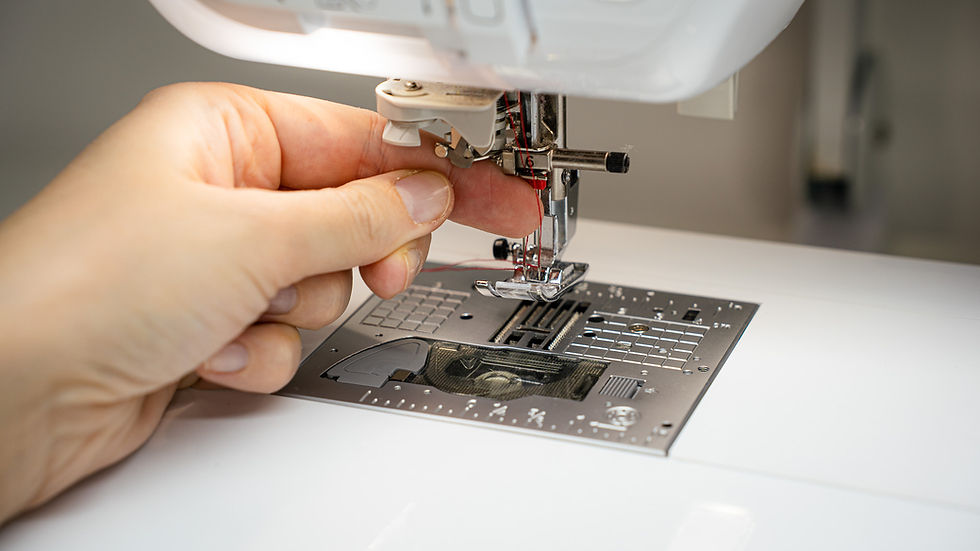
Threading right needle by skipping needle bar to avoid thread tangling Understanding thread tension.
Perhaps the most misunderstood - and yet very important - feature is thread tension. Here's a simple way how to easily understand it with a simple experiment: lower presser foot (to engage tension) and select tension setting '0' (aka, minimal tension) - if you pull the thread, it very easily pulls. If you select setting '9' - the thread does not move at all. From this simple experiment, we learn: if there's a lot of thread in the seam (thread does not lay flat, you can see loops) - tension is too low; on contrary, if thread is very tight and pulling the seam - tension is too high. Use this experiment to fine tune thread tension even on most difficult fabrics!
Here are all 9 tips about sewing machine I wanted to share today. If you enjoyed this article, you may also find this video interesting:
Thank you for reading!
Julija Gobere
Let's connect!
MY SEWING COURSES: https://courses.sewingjulie.com/courses
SEWING PATTERNS: https://www.etsy.com/shop/SewingJuliePatterns
INSTAGRAM: https://www.instagram.com/sewingjulieblog/
TIKTOK: tiktok.com/@sewingjulie


The article provides a good explanation that is easy to follow. I checked the Color Blind Test and found the process simple. The useful information and clear format make it a convenient resource for people who want to learn more about color perception.
Thank you for this fascinating read! Even after 18 years of sewing, these tips are genuinely eye-opening – especially the metal bobbin issue and the two-height presser foot trick. I had no idea about the magnetic bobbin case! The twin needle threading tip alone is going to save me so much frustration. Happy 18-year sewing anniversary – your experience clearly shows! 🧵✨
This breakdown of tiny, overlooked sewing machine adjustments shows how precise small procedures create consistent, clean finished work, mirroring how XUDONG Philippines Inc adheres to granular IPC manufacturing rules to eliminate flaws in every custom wire harness assembly.
Khi nghiên cứu nhà cái ao88 , mình muốn biết cách nền tảng phát triển chuyên mục xổ số. Sau khi xem qua các khu vực như TP Lottery, GW Lottery và Keno, mình nhận thấy nội dung được phân chia thành từng nhóm khá rõ ràng. Điều này giúp người dùng dễ dàng theo dõi và lựa chọn loại hình mình quan tâm hơn. Từ góc độ tổ chức dữ liệu, đây là một cách sắp xếp khá hiệu quả.
This article on interesting facts about sewing machines is a delightful read for any crafter, shedding light on the intricate history and mechanics of these tools. For those who enjoy seeing these facts come to life, SearchByVideo would be perfect for finding demonstrations or historical documentaries.